One Letter at a Time: Britain's Quiet Push Into Base Editing
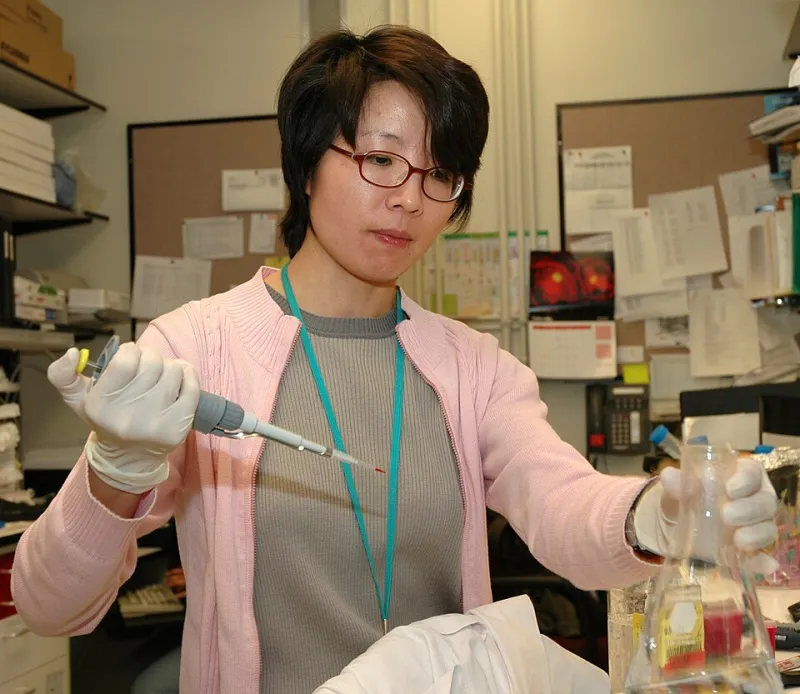
Photo: Diane A. Reid (Photographer), Public domain, via Wikimedia Commons
The public image of gene editing is a pair of molecular scissors. CRISPR-Cas9 cuts clean through both strands of the double helix and leaves the cell to stitch the break back together — a powerful but blunt arrangement that produces a mixture of small insertions, deletions and, occasionally, precisely the change intended. Base editing dispenses with the scissors. It nicks one strand, parks a modified enzyme alongside a target letter, and chemically converts that letter into another. No double-strand break, no reliance on the cell's repair machinery getting it right.
That distinction sounds like a technicality. It is not. It reframes what gene editing is for: not the destruction of a gene, but the correction of a typographical error.
Two families of editor, and a narrow alphabet
Most base editors are built from a Cas9 variant that has been disabled from cutting both strands, fused to a deaminase enzyme. Cytosine base editors convert a C·G pair into T·A; adenine base editors convert A·T into G·C. Between them they cover the four transition substitutions.
That is a deliberately small alphabet. Base editors cannot perform transversions, cannot insert sequence, and cannot delete a stretch of DNA. They work inside a short editing window, typically a handful of bases from the protospacer adjacent motif that the Cas9 component needs in order to bind at all. If a disease-causing variant falls outside a usable window, or sits next to a second cytosine that also gets converted — the bystander problem — the tool simply does not fit. Prime editing, developed later, extends the repertoire to small insertions and deletions, at the cost of greater complexity.
For a research field accustomed to headlines about correcting any mutation anywhere, this narrowness can read as a limitation. In practice it is the source of base editing's appeal: a tool with a defined scope is easier to characterise, easier to validate and considerably easier to explain to a regulator.
Why a single letter is enough
The clinical case rests on how common disease-causing variants actually look. Sickle cell disease turns on a single substitution in the beta-globin gene. Beta-thalassaemia frequently involves point mutations in the same region. Alpha-1 antitrypsin deficiency, one of the better-studied targets for liver-directed editing, is most often caused by the PiZ substitution. Familial hypercholesterolaemia is a collection of point variants, some of which lend themselves to disruption of a regulatory site rather than correction of the gene itself.
Some conditions fit less neatly and it is worth saying so. The most common cystic fibrosis variant in the UK, F508del, is a three-base deletion rather than a single substitution, which places it largely outside the reach of first-generation base editors. Duchenne muscular dystrophy often involves large deletions. The technique's reach is real, but it is drawn by the shape of individual mutations, not by the prominence of the disease.
Where British strengths genuinely lie
British contributions to base editing are less about inventing the chemistry — the founding work came from American laboratories — and more about the unglamorous middle ground where a promising molecule becomes a medicine.
Genome-wide screening capability concentrated at the Wellcome Sanger Institute has made the UK unusually good at predicting which edits will work and which will cause collateral damage. Structural and protein-engineering expertise around Cambridge, including at the MRC Laboratory of Molecular Biology, feeds directly into editor design. Haematology groups in London, Oxford and Newcastle have deep experience in manipulating blood stem cells ex vivo, which is the route most near-term base-editing therapies will take. Edinburgh and Oxford add strength in delivery and in the immunology of viral vectors.
The UK's institutional advantages matter too. The Advanced Therapy Treatment Centre network created manufacturing and trial capacity that small academic groups could not otherwise afford, and the MHRA's decision to authorise the first Cas9-based therapy for sickle cell disease in late 2023 signalled a regulator willing to engage early with unfamiliar modalities rather than wait for others to move.
Delivery is still the hard part
An editor that cannot reach the right cell is a laboratory curiosity. Ex vivo approaches — removing a patient's stem cells, editing them outside the body and reinfusing them after conditioning — remain the most tractable, and also the most demanding, requiring chemotherapy, hospitalisation and specialist centres. In vivo delivery to the liver via lipid nanoparticles is more elegant, and early clinical work internationally has shown that editing a handful of liver cells can produce a durable biochemical effect. Getting beyond the liver, into muscle, lung or the central nervous system, remains largely preclinical.
Then there is the safety question that occupies regulators most. Base editors avoid double-strand breaks, which reduces the risk of larger chromosomal rearrangements, but they still create a nick, still depend on a guide RNA, and can still act at near-identical sites elsewhere in the genome. Off-target analysis by whole-genome sequencing, rather than prediction alone, is now the expectation at the point of licensing.
What UK regulators and payers will ask
The MHRA has an established route for advanced therapy medicinal products and an innovative licensing pathway for products that address unmet need. Alongside it, NICE's highly specialised technologies programme provides a route to funding for very rare indications, with a higher cost-effectiveness threshold than standard appraisals.
The awkward issue is not approval but purchase. A one-shot therapy priced like the current generation of haematological gene therapies sits uneasily against an NHS budget that pays in annual instalments. Any base-editing product reaching a UK clinic will need either a far lower price or an outcomes-based arrangement in which payment is spread and tied to durable response. That is a commercial problem dressed as a clinical one.
Which patients may be reached first
On current evidence, sickle cell disease and transfusion-dependent beta-thalassaemia are the most plausible first arrivals in UK clinics, because the ex vivo infrastructure exists, the patient populations are well characterised, and there is a licensed precedent to point to. Liver-directed base editing for familial hypercholesterolaemia is scientifically elegant, but it must clear a higher bar: the condition is already managed with statins and injectable inhibitors, so a permanent edit has to be exceptionally safe before it displaces them. Alpha-1 antitrypsin deficiency is smaller but arguably easier to justify. Inherited retinal disease and selected metabolic disorders are likely to follow through academic trials rather than industry programmes.
Realistically, licensed base-editing therapies should be expected in the early 2030s rather than the next eighteen months, with academic trials bridging the interval.
A narrow tool, precisely aimed
Base editing will not replace CRISPR-Cas9, and it will not deliver the fantasy of editing any mutation at will. What it offers is something more useful: a way of making a defined change, in a defined tissue, with a safety profile that can be described in plain terms to a regulator, a clinician and a patient.
That modesty is the point. The British research base appears to have grasped it, and the programmes most likely to succeed are those that have chosen their targets by mutation rather than by ambition. In a field prone to overstatement, a pencil may prove more valuable than a pair of scissors.